I am the Traveling Grant and this is the blog of my life and travels. I have now lived in Japan for three years of the past five, currently making my home in the city of Maebashi outside of Tokyo.
Wednesday, September 08, 2010
Tosho-gu
Located in Tochigi Prefecture north west of Tokyo, Nikko has been a worthwhile destination for centuries. The primary draw for the past couple of hundred years is Tosho-gu, the shrine that is the final resting place for Tokugawa Ieyasu.
Tosho-gu was built by Ieyasu's son Hidetada, and enlarged by his grandson Iemitsu. They needed a grand and glorious gesture to show the power and wealth of the still new Tokugawa Shogunate. Japan had just come out of a long period of civil war and disunity, and the Tokugawa made every effort to forestall any slide back into chaos. That their own heads would have been first on the chopping block in that event was certainly an added motivation.
The various shrine complexes are set a short ways up from the town itself, and an easy walk from the train station. Nikko is a very popular day trip from Tokyo, and it is easy to see why. It provides a remarkable contrast to Ieyasu's old capital, with the tall forests and ornate shrine buildings a far cry from the busy streets around Shinjuku.
Nikko is rather unique in Japan, far more gaudy and ornate than is usually the case in Japanese religious buildings. In that way it shares a certain aesthetic similarity with some of the traditional buildings I saw in China, bright and colorful as opposed to the more standard unpainted wood.
Indeed, Nikko can be overwhelming to the senses, especially when you factor in heat, crowds and a surfeit of steps. (I was at Nikko three days after Fuji, and had mostly recovered, but the steps triggered a measure of Post Traumatic Mountain Stress Syndrome in my calves.)
I have been to Nikko before, by myself over five years ago. That trip was during a very chilly mountain March, so I was quite glad to return with friends. Though the occasional drizzle merely made the late August heat even wetter and stickier and made the dirty snow piles of March an attractive alternative.
After an extra fee and a hike up more stairs into the woods you come to the burial place of the man who unified Japan. It does seem ironic that once you get past the Rococo meets East Asia styling of the shrine buildings, Tokugawa's mausoleum is an understated bronze cylinder that still holds whatever remains of his ashes, these hundreds of years later.
Sunday, September 05, 2010
Driving to Nikko
Nikko is one of the premier tourist destinations in Japan. It is an area of immense natural beauty and historical importance that has the good fortune to also be quite close to Tokyo. Nikko sits in the mountains to the north of Gunma, about two hours drive from my house. My old friend Zach and his girlfriend Miku came up to Gunma from Osaka during summer break, meeting up with me and our mutual friend Ryan. We planned a drive to Nikko, as Miku had never been!
While enroute we came across an old Imperial getaway that is now a museum. Originally built for the local lord, the small palace was obtained by the Imperial Family during the Meiji Restoration in the late 1800s, and was expanded and made more luxurious, as befits an Emperor.
Now of course, it is a museum that gives a look into the very private lives of the Japanese Imperial Family. There are displays on the history of the building, old Japanese building techniques, and of course rooms that show how the Imperial Family lived, from the shower room to the audience room to the billiards room.
This was a very nice surprise, everyone but Miku had been here before, some multiple times. It was just far enough away from the central tourist sites of Nikko that you wouldn't know about it without prior planning or a car. Just one of those happy accidents that happens when you are traveling.
Monday, August 30, 2010
Nick's Tokyo
My old friend Nick, a fellow ex-GEOS teacher, visited back in early August. While he had lived near me in Ishikawa Prefecture for a year, he had never managed to visit Tokyo. So when he visited, a couple of days in the capital were our first stop.
And the first stop in the capital is always The Metropolitan Government Building in Shinjuku. The building itself is plenty impressive, and the views of the sprawling megalopolis below are always staggering. We were lucky to have a nice clear day, and could see all the way to Yokohama. The boxy building in the center of the above photo is the Yokohama Landmark Tower, the tallest building in Japan, and currently the third tallest structure.
Sadly, the area around Mt. Fuji was wreathed in clouds, and not visible. That darn mountain has hidden its face from me each time I've been in one of the many observation lounges that dot Tokyo. One of these day's I'll get it on 'film'. It owes me after the typhoon business.
Dinner that night was shabu shabu, one of my favorites and a dish Nick hadn't tried yet. The basics are similar to fondue or a Chinese hot pot. This strips of meat, chunks of tofu, veggies, and noodles are cooked in a pot of boiling water. They are then dipped in one of two sauces, the tart soy and vinegar based ponzu sauce or the creamy sesame based goma sauce. With the pot of boiling water in the center of the table, shabu shabu is more suited to a cold winters day, but washed down with plenty of iced beer we survived.
All that was left to do in Shinjuku was explore the bustling area under the bright city lights that make Tokyo nights almost brighter than Tokyo days.
Wednesday, August 25, 2010
Poo what a stink!
At the base of Mt. Shirane is the resort town of Kusatsu. Kusatsu is one of the most famous hot springs towns in Japan, and is one of Gunma Prefecture's primary tourist draws, with highway buses direct from Tokyo. I've been accused of being an "Onsen Otaku" before, and for the most part it is true. I love going to the hot springs baths. It really is just about the most relaxing thing I can think of, even better than going to the beach, and closer too.
The main spring bubbles up right in the center of town, in an area called the Yubatake. The mineral rich water steams as it flows along wooden channels and into a pool, making the whole town center stink of sulfur. There is even a notice that the Yubatake is one of "100 Scenic Spots of Peculiar Smell" in Japan. I do wonder where the other 99 are, and what they all stink of.
The town is jammed to the rafters with onsen, some free, some paid, some indoors, some outdoors. This one here is said to be the oldest in town, and is hands down the hottest bath I've ever almost taken. I say almost taken because I couldn't submerge my legs for more than a few seconds, and sticking my whole body in the water was out of the question. Luckily, there are plenty of other, cooler baths available. One pay complex on the edge of town has an indoor bath, outdoor bath and sauna, and has to be one of the best hot springs I've ever visited, despite the smell.
Friday, August 20, 2010
Fuji
The wind howled through the misty, rain swept blackness. Below, a trail of lights faded into the distance. Above, the same trail seemed to climb forever. The universe was a cold conglomeration of black rock, black night, screaming winds and and frigid horizontal rain. I had to ask myself, just what the heck was I doing here?
Much earlier that day, our group of climbers assembled at the 5th Station, at about 7,000 feet above sea level, roughly half way up the sloping cone of Mt. Fuji. One of the group, Peter, had decided that he wanted to truly climb the entire mountain and had spent the day hiking from the 1st station. Saner climbers tend to skip that step, making straight for the 5th station, and its collection of restaurants, bus stops, souvenir shops and vending machines.
As we trickled into the meeting area the early clouds burned and blew away in the wind, leaving a crystal clear blue sky. A typhoon was forecast, but there was no evidence in the glorious, near perfect weather to start a late afternoon climb.The vast cone of Fuji-san thrust above, naked and dark with its winter coating of snow long since melted. The black ash and lava flows made for an uninviting peak, and the speed at which the clouds passed over the summit were an unheeded warning that the climb would be less pleasant than hoped.
For most climbers, the plan is to start late in the day, climb through the evening and then sleep in a mountain hut. After a scant few hours of rest you finish the climb and enjoy the glory of a high mountain sunrise. Those of us who can't really afford the rather steep prices of the huts, about $70 for the cheaper ones, choose instead to climb through the night, forgoing sleep and warmth to be the first to the top, and the dawn.
The gentle opening phase was an absolute joy. Despite the recent rains, and the occasional cloud misting its way past us, the weather was perfect for hiking. Not too hot, not too cold, not too dry, not too wet. The trail was well built and maintained, ready for the thousands of people that hike Fuji every year. Our group joked, bantered, took photos, and just enjoyed each others company and this wonderful climb.
The day waned, and the sun began to sink along the other side of the peak, casting a great shadow across the clouds. The trail climbed ever higher, the omnipresent overcast of Japan becoming a far away carpet of cotton balls below.
Full night eventually settled, and the stars, so shy in this overly illuminated nation, came out in all their glory. Climbers who thought to turn off their head lamp for a moment were treated with views of Cassiopeia, The Big Dipper, even the Milky Way. In the distance the vast urban megalopolis of Tokyo could be seen, brilliant lights shining all the way from Yokohama on the coast to Omiya near the mountains. As the night drug on and the altitude increased, the wind picked up, and the cold began to settle.
Layers came out, first an extra t-shirt, then a fleece, then a shell, then a hat, finally gloves. We had all walked from sticky summer to frigid winter in just a few miles. The summit and sunrise were driven out of mind, they were many hours off in a remote and unseen future. What mattered was the smaller indications of progress. The next station, the next hut, the next switchback. There was an udon restaurant at the top of the 8th station that became more sought after than heaven itself. We knew it was there, we knew it would be glorious.
Naturally reality was less inviting than the fantasy, but two hours of cat naps and hot food prepped the group for the next challenge, or so we had thought.
It seemed that no sooner had the 8th station faded behind than small flecks of rain appeared in the glow of the headlamps. Faint at first, hardly worthy of notice, yet certainly a harbinger of difficulties to come. Soon, the lights of the cities and the huts below vanished in the enveloping clouds. We went from the top of the world to our own world, cut off from everything and everybody. The end game had arrived, the summit was close. Every step became harder, every foot of elevation gain more precious as we all climbed further into the teeth of the typhoon. The climb grew ever more difficult, fog, rain and exertion rendered glasses useless, and any exposed article of clothing became sopping wet.
At last, the summit of Mt. Fuji, 12,388 ft above sea level. The winds and rain whipped by stronger than ever, speaking was impossible, and waiting for sunrise near suicidal folly. One imperative, one simple goal remained. Descent.
Having stowed my glasses in my pack, I carefully picked my way through the darkness and the jagged black volcanic rocks. They winds gusted at over 70 mph, enough to shift a climber even if he wasn't moving, and more than enough to send you tumbling to the ground if you weren't ready for it.
Slowly, gently definition returned to the world. The black sky became imperceptibly lighter, and then lighter again. The winds and rain remained, but the dawn had finally arrived.
The sun illuminated the trail, and gave visual representation to the speed of the winds, as the clouds sped past us. The sunrise was visible only in spurts, hidden then revealed again by the scudding of the clouds. The pestering rains and winds never stopped, never showed mercy.
Any decent is a labor, with energy, water, and food running low, but after a rain soaked, wind whipped, typhoon torn climb through the night, the hike down was undoubtedly the most difficult of my life. The winter hat would unravel into my face, blocking my vision. Clenching my fists in my gloves was like wringing out a wash cloth in the shower, except that they never got dry. Heavy, clammy jeans clung to my legs reminding me that I knew better than to wear jeans in the mountains. The humid mid August heat of Japan seemed a far off memory, something that had never been, could never have been real.
Every time there was a lull in the wind, when the thought that "perhaps it will be easier now" would cross your mind, a cannonade of air would shoot across your back, and remind you that it wouldn't end until you reached the car.
By this point our group of five had splintered into three components. At the top of the 7th station Nick and I encountered a group of rangers who were putting together a 'safety road'. Rather than descend the occasionally rocky ascent trail we had been using, they shunted a large group onto the bulldozer path that provides supply to the mountain huts. The going was much easier on the sandy path, and the line made good time down to the bottom of the 7th station. The end was in sight, but the wind and rain seemed stronger than ever. The urge to be done of this peak, to be home, to be warm, to be fed, to be rested was overwhelming.
Then, a glimpse through the clouds, the fifth station was near. Close, closer, and finally, hands clasped in a ragged cheer we were there. Down. Done.
Well, done except for the three hour drive home anyway...
Friday, August 06, 2010
Where the road sings
Most of the volcanoes in Gunma are extinct, or at least long dormant. They may erupt again, some day, but all signs point to a nice peaceful slumber for the present. However, in the far northern part of Gunma, near Nagano, there are a few mountains that are a little more awake. One of these is Mt. Shirane, an 7,123 foot volcano that last erupted in 1983.
Like Mt. Aso in Kyushu, the summit crater contains a milky blue acidic lake that reeks of sulfur. In fact, the entire mountain has a faint sulfur smell. The road to the top passes through an area of vents and springs that spew sulfur into the air. Foolishly I rolled down my window during that portion of the drive, and the smell stayed in the car for quite some time!
The locals put all that hot sulfur water to good use, the large and famous spa town of Kusatsu is nestled at the base of the mountain. The highway to Kusatsu is called the Japan Romantic Road, and on a segment right before the town there is a melody road. You know the grooves that are sometimes cut in the side of the road to wake you up if you go to far over? A melody road is like that, but the grooves cross the whole road, and the tones you hear make up a song.
I had known there was a melody road somewhere in Gunma, but never quite where it was, so I was pretty surprised when these weird noises enveloped the car!
The top of Shirane was a delight, far cooler and less muggy than the flats down below. The day before I had been in Tokyo, and difference in climate was very noticeable, and very welcome.There were a variety of hiking trails along the top, but Travis's leg was in a fair amount of pain from an old soccer injury, and he wasn't up to do much walking.
As we had been driving up, I was surprised to see highway buses negotiating the road to the top, direct from Shinjuku in Tokyo. The area is known to local tourists, but I don't think Shirane is very high on the list for people visiting Japan, which is a shame. There aren't many easily accesible active volcanoes in the world, and while Shirane may not have the cache and lava explosions of Kilauea it is still a great place to visit.
Wednesday, August 04, 2010
The smell of charcoal
Living anywhere requires certain sacrifices, often of a culinary nature. Back in America it is hard to find such things as Japanese style curry, okonomiyaki, or yakitori. Here in Japan, it is Mexican food, and think juicy burgers that have gone missing.
In a quest to honor summer with an old and sacred tradition, yesterday Scott and I decided to try our hands at grilling burgers. We had a very interesting time of it. I like to think of myself as a pretty hot hand behind a grill, but I was humbled by the experience, even though the end result came out pretty well.
Grilling is actually quite popular in Japan, but with some significant differences to the art as practiced in the States. Here they tend to prefer more of a yaki-niku style with grilling small bits of marinated meat, or shish-kebob style with skewers of meat and veggies. Burgers, hot dogs and steaks aren't really on the menu, and that complicates things. Japanese charcoal grills are designed differently, with a small mesh covering suitable for smaller chunks of meat. This makes flipping burgers a bit more of a challenge, especially when the meat is a mix of pork and beef instead of the all ground beef I am used to.
The real challenge however was starting the fire in the first place. I'm a Boy Scout, I know how to light things on fire, especially if these things are stacked in a grill. However, the local hardware store didn't sell lighter fluid, rather they sold lighter gel, a thick, pink concoction that merely sat on the charcoal and smoldered weakly. We eventually figured out that rather than soak into the charcoal, the gel was more of a kindling source, something to place beneath the pile. This lesson cost us at least thirty minutes and about half of the five dollar bottle of fluid.
Our next attempt at a roaring fire was more successful, though it was a bit too successful. Scott returned from the store with a new kindling source AND a small, mini blowtorch especially for fire starting. These two efforts combined finally set the charcoal alight, but the blowtorch had a tendency to stir up storms of sparks. These sparks then landed on our feet, legs, arms and burgers, burning small holes everywhere. The burgers didn't really mind, but I did. Those sparks hurt! We were lucky that we weren't in Colorado, as we probably would have lit half the state on fire with that thing.
Despite our troubles, the finished product actually tasted pretty good. It had been a long time since I had tasted a home grilled blue cheese burger, and I was delighted to finally get the chance.
The good news is we still have the grill, blowtorch and a wee bit of blue cheese left, ready for next time.
In a quest to honor summer with an old and sacred tradition, yesterday Scott and I decided to try our hands at grilling burgers. We had a very interesting time of it. I like to think of myself as a pretty hot hand behind a grill, but I was humbled by the experience, even though the end result came out pretty well.
Grilling is actually quite popular in Japan, but with some significant differences to the art as practiced in the States. Here they tend to prefer more of a yaki-niku style with grilling small bits of marinated meat, or shish-kebob style with skewers of meat and veggies. Burgers, hot dogs and steaks aren't really on the menu, and that complicates things. Japanese charcoal grills are designed differently, with a small mesh covering suitable for smaller chunks of meat. This makes flipping burgers a bit more of a challenge, especially when the meat is a mix of pork and beef instead of the all ground beef I am used to.
The real challenge however was starting the fire in the first place. I'm a Boy Scout, I know how to light things on fire, especially if these things are stacked in a grill. However, the local hardware store didn't sell lighter fluid, rather they sold lighter gel, a thick, pink concoction that merely sat on the charcoal and smoldered weakly. We eventually figured out that rather than soak into the charcoal, the gel was more of a kindling source, something to place beneath the pile. This lesson cost us at least thirty minutes and about half of the five dollar bottle of fluid.
Our next attempt at a roaring fire was more successful, though it was a bit too successful. Scott returned from the store with a new kindling source AND a small, mini blowtorch especially for fire starting. These two efforts combined finally set the charcoal alight, but the blowtorch had a tendency to stir up storms of sparks. These sparks then landed on our feet, legs, arms and burgers, burning small holes everywhere. The burgers didn't really mind, but I did. Those sparks hurt! We were lucky that we weren't in Colorado, as we probably would have lit half the state on fire with that thing.
Despite our troubles, the finished product actually tasted pretty good. It had been a long time since I had tasted a home grilled blue cheese burger, and I was delighted to finally get the chance.
The good news is we still have the grill, blowtorch and a wee bit of blue cheese left, ready for next time.
Wednesday, July 28, 2010
Myōgi-san
Mt. Myōgi is one of the three Mountains of Jomo (Gunma), along with Mt. Haruna and Mt. Akagi. It is the furthest away from me, and the final one that I visited. After our group had so much fun on Mt. Tsukuba, we decided to tackle another hike the next weekend.
Like Akagi and Haruna, Myōgi is of volcanic origin, though it is far, far older than its two sister peaks. The massif is long extinct, and heavily eroded. Myōgi has no graceful hump, but instead a chaotic mass of spires and ridges, perfect for the adventurous rock scrambler.
There are ladders and chains to hold on to for the tricky parts, though I'll admit even the ladder up to this spire was a bit too exposed and a tad slick for my tastes, though I made it safe and sound. We got an excellent group panorama, and then headed further up the mountain for more scrambling and more vistas.
The climb wasn't technical, but it did demand a sure foot and a steady hand. The heat and humidity conspired to make my hands pretty slick, and while this section was no problem, there was a pretty sheer face later on that had me a little worried, with steep, slick rocks and wet hands.
The views we were rewarded with were far more expansive than those on Tsukuba, though the hiking was much more strenuous, as a few of the party were quick to point out!
I'd learned my lessons from Tsukuba, and had stocked a face towel for sweat and a pair of two liter water bottles from the store, though I found that a pair of hiking boots would have been fantastic to have on hand, especially for the steeper bits of rock scrambling. Despite the heat, humidity, and angry wasps I've fallen even more in love with hiking in Japan, and a return to Myōgi to climb a little higher is certainly in order, as are further vertical exploits. Fuji, here we come!
Monday, July 26, 2010
High Summer
The rainy season is officially over, though it went out with a bang a few days ago with a lightning storm that rocked the whole neighborhood. I unplugged my computer and hoped for the best, we had some pretty close hits. I've learned my lesson too, about trying to shoot lighting when the storm is right over your head. On a side note, the top three photos here are all panorama stitches, and I recommend clicking on them to get a larger view of all the details.
The weather has generally been clear and beautiful, but sticky and hot. Standing in front of a gaggle of elementary students doing activities and singing songs in a classroom with no A/C is not an experience I recommend.
However, now it is summer break, which stretches from late July to late August for me, though some have longer. It's not as epic as we used to get back in my Elementary School days, but it's certainly the longest employed time off I've had in forever. I just wish I had enough money to really travel and go somewhere new (like Korea!), but I'll be spending the month in Japan, hiking, hanging out, and entertaining guests.
Summer also brings with it fireworks, and ever town in the region is having their own display, so if you plan it right every weekend you can catch some fireworks somewhere in the area. Last weekend we had a show in Tamamura, and I made sure to catch at least part of the show, though traffic and a late start meant I only caught the last 15 minutes or so, but I wasn't too worried because there will be more where that came from. Tamamura was the first show of the summer, but far from the last!
Friday, July 23, 2010
Tokugawa Ieyasu: Shogun
When browsing for English books on Japan, you will find a great many that cover recent Japanese history. Reams have been written about the fall of the Tokugawa Shogunate, the Meiji Restoration, World War II and the course of Modern Japan. You can also find plenty of books that cover general historical topics like samurai or castles. However, I have had a hard time finding a book that zeros in on the details of the reunification of Japan and the rise of the Tokugawa Shogunate in the late 16th and early 17th centuries.
Ever since I read James Clavell's Shogun I have wanted to read an actual history about the three great unifiers, Oda Nobunaga, Toyotomi Hideyoshi, and of course Tokugawa Ieyasu. While I haven't found a book that fulfills that criteria, a friend pointed me towards this book, Tokugawa Ieyasu: Shogun by Conrad Totman. In a brisk 197 pages the book concentrates on Ieyasu's life from about 1599, and his successful reunification of Japan through diplomacy and force. We see the diplomatic acrobatics that he used to build an maintain his power base, as well as the ruthlessness of the time. If a letter or a new wife wouldn't sway you to Tokugawa's way of thinking, a sword probably would, though of course by then it was too late.
The book flits about geographically quite a bit, and it was fun for me as many places I know popped up in the text. Tokugawa was born in the castle town of Okazaki, which of course was where I worked back in September of 2005. The books also spends a fair amount of time in the Kansai region, especially the cities of Osaka and Kyoto. Edo (Tokyo) gets a fair amount of words as well as Totman describes the cities development from a muddy village to the base of the most powerful family in Japan. Kanazawa gets a few mentions as well as some areas I know near to Ogo!
Really the only problem with the book is one rather inherent in Japanese History generally, names. The major daimyo (feudal lords) of the era all crop up rather often, as do their sons, grandsons, cousins, brothers, and more. Throw in shifting alliances, a multitude of wives and a plethora of children and sometimes it can be hard to figure out just who is doing what.
That said, this really is an excellent introduction to a very complex and fascinating period in history.
Ever since I read James Clavell's Shogun I have wanted to read an actual history about the three great unifiers, Oda Nobunaga, Toyotomi Hideyoshi, and of course Tokugawa Ieyasu. While I haven't found a book that fulfills that criteria, a friend pointed me towards this book, Tokugawa Ieyasu: Shogun by Conrad Totman. In a brisk 197 pages the book concentrates on Ieyasu's life from about 1599, and his successful reunification of Japan through diplomacy and force. We see the diplomatic acrobatics that he used to build an maintain his power base, as well as the ruthlessness of the time. If a letter or a new wife wouldn't sway you to Tokugawa's way of thinking, a sword probably would, though of course by then it was too late.
The book flits about geographically quite a bit, and it was fun for me as many places I know popped up in the text. Tokugawa was born in the castle town of Okazaki, which of course was where I worked back in September of 2005. The books also spends a fair amount of time in the Kansai region, especially the cities of Osaka and Kyoto. Edo (Tokyo) gets a fair amount of words as well as Totman describes the cities development from a muddy village to the base of the most powerful family in Japan. Kanazawa gets a few mentions as well as some areas I know near to Ogo!
Really the only problem with the book is one rather inherent in Japanese History generally, names. The major daimyo (feudal lords) of the era all crop up rather often, as do their sons, grandsons, cousins, brothers, and more. Throw in shifting alliances, a multitude of wives and a plethora of children and sometimes it can be hard to figure out just who is doing what.
That said, this really is an excellent introduction to a very complex and fascinating period in history.
New Old Kanda
While I was looking for older photos for the Akihabara, I found these pictures I took from Kanda Station back in August of 2007 but never blogged. Technically speaking these aren't proper Yamanote shots as I took them from the Chuo Line tracks. The Chuo line cuts right through Tokyo, connecting the East and West sides in a very convenient fashion. I'm off to Tokyo this weekend, for training and fun, so I should have a whole new batch of stations ready to keep the project going for a while.
Wednesday, July 21, 2010
Tsukuba-San
When I came to Japan in March I had been told I was going to Ibaraki Prefecture, and so I did a lot of research. Of course I was eventually placed in Gunma, but I still have several good friends in Ibaraki that I did training with. One of them invited me to climb Mt. Tsukuba as a prelude hike to Mt. Fuji, which we hope to climb in August. My day started pretty early to make it to Ibaraki by 11, and it included travel on this one car diesel train, a rarity in the generally electrified grid of Japanese rail.
Mountains are often sacred to Shinto, and Tsukuba-san is no different. There is a beautiful large shrine at the base of the peak, and the trails start from there.
It has been a while since I had done much hiking, and for most of our group this was their first hike. We weren't quite prepared, especially water wise. Luckily one of us had brought a fair amount of extra water, so those of us who had only packed a little bit were saved. I really should (and do) know better, but I wasn't quite prepared for how the heat and humidity of Japanese summer affects hiking. To put it briefly, you sweat, a lot. I've now learned that any hike in Japan had better be accompanied by a small towel around your neck to absorb the sweat pouring off your face.
Despite the heat and the sweat, the hike was lovely. I had almost forgotten just how much I love hiking. The lush green forests were a remarkable contrast to the dry pine forests and wide open fields of the Rocky Mountains. The trail was also quite busy, but mostly with people coming down the peak after riding the cable car to the top!
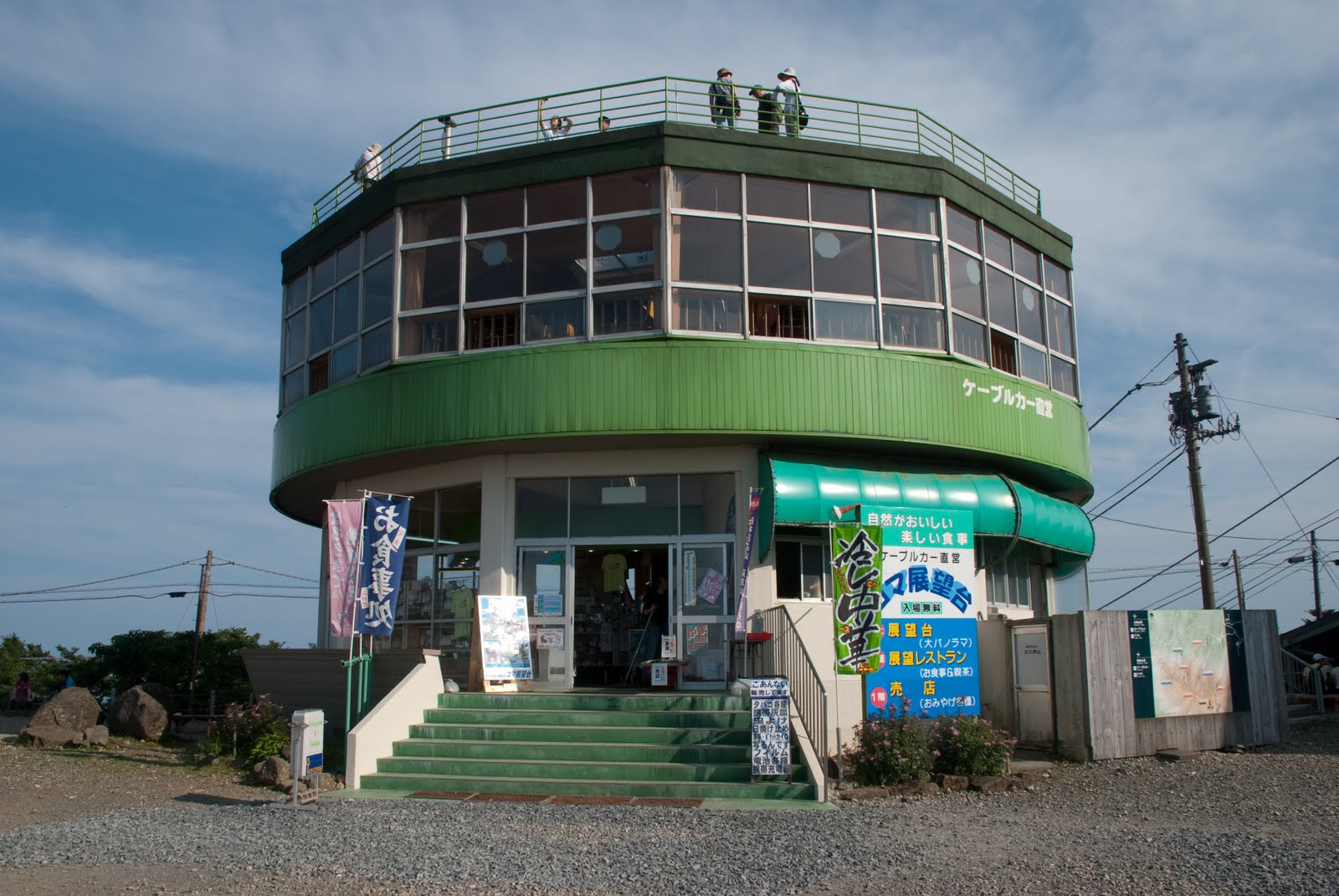
As always once we got to the top all the work it took was forgotten as we looked out over the flatlands of Ibaraki Prefecture. Unlike most Colorado Mountains, there were vending machines, a restaurant, and a gift shop up top, so we had plenty to amuse ourselves with other than the view!
Though I must confess, we didn't actually make it to the TOP, rather we made it a large saddle that is between Tsukuba-san's two peaks. We were up very late in the day (5:00), and had to head down to avoid hiking down in the dark, as we were utterly unprepared for that. I suppose that means I have unfinished business in Ibaraki Prefecture, and I may just have to head back and make it to the top of BOTH peaks, and not take the cable car down next time....
Subscribe to:
Posts (Atom)