Showing posts with label Tohoku. Show all posts

Friday, January 06, 2012

Riding the Shink


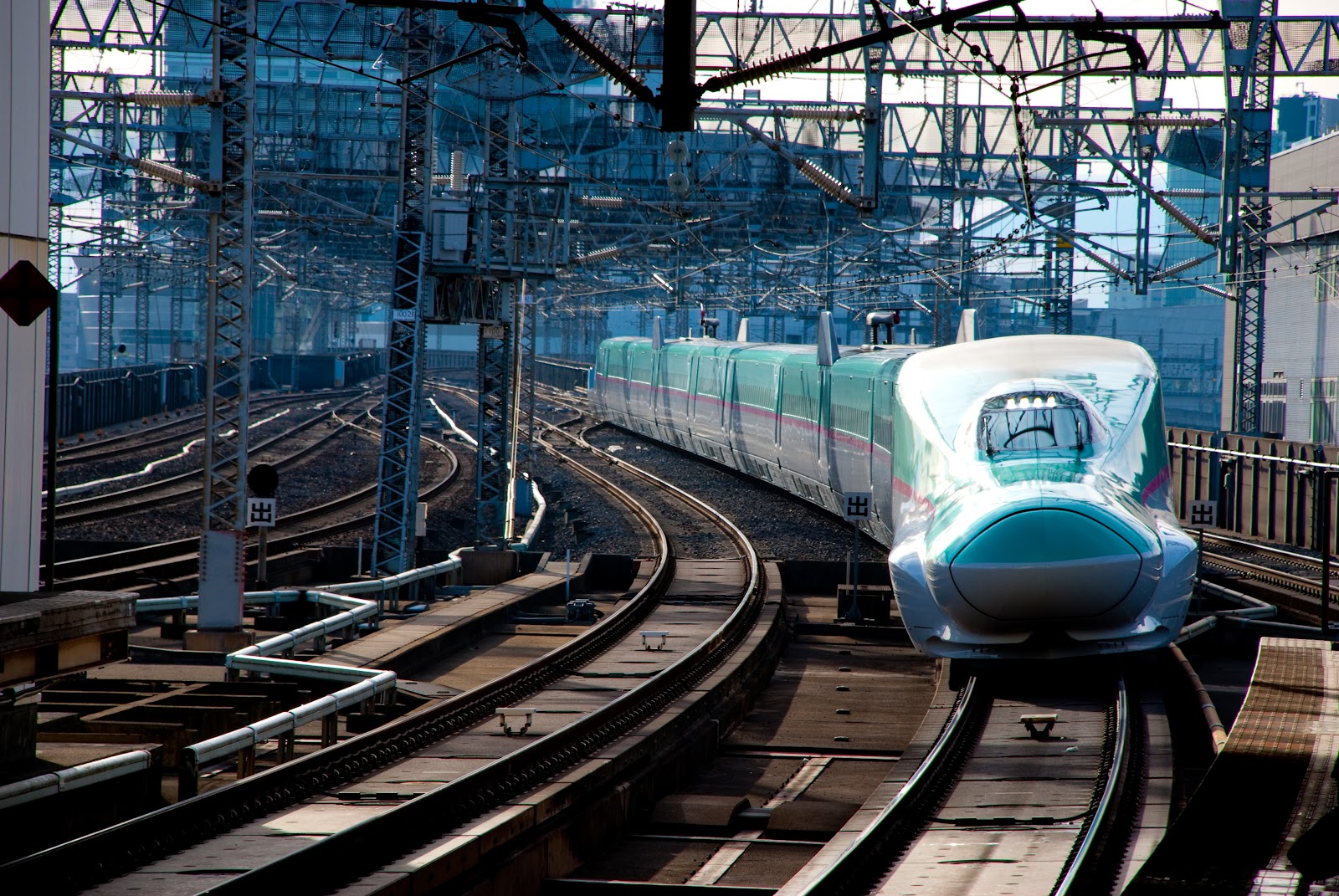
 Shortly after Christmas Tess and I took a trip to Sendai. One reason we wanted to go was less about Sendai and more about the mode of transportation you can use. The new E5 Series Shinkansen, which runs the northern route from Tokyo to Aomori Prefecture at the far tip of Honshu.


We had to change trains at Omiya station, to catch our E5 Hayabusa. This is the newest Shinkansen, and only went into regular service last March, just a few days before the earthquake disrupted the northbound trainlines. 


This new trainset is one of the sleekest yet, and has a top design speed of 320 km/h (299 mph), but currently only runs at 300 km/h (186 mph). This is still fast enough to cover 321 kilometers between Omiya and Sendai in a mere 71 minutes. 


I have always said that the Shinkansen is the only way to travel. For pure speed and comfort, it is just pure bliss on tracks. And the new trains are even better!

Sunday, March 20, 2011

Spring, a time for Beginnings.

The week since the great quake has certainly been one of the strangest of my life, filled with hopes, fears, friends, endings, beginnings and more. People around the globe have had an eye on the unfolding nuclear crisis in Fukushima. While the affected reactors are pretty far away, they are close enough that everybody in the Kanto region have been keeping at least one eye on the news.

There has been a bit of an exodus here of late, with a lot of ALTs taking a quick vacation home. Some aren't coming back either. I'm not sure how I feel about that to be honest. I understand the desire to ensure your own safety, and to seek comfort in family and friends. But I also feel that the crisis, while certainly very serious, has been blown out of proportion by the media. Though I also wonder if I should be less sanguine about it all. I'm watching the news, and prepared to leave if I have to, but I'm not losing any sleep about my possibly glowing in the dark someday. I suppose only time will tell if I am foolish or simply sensible.

The weather is turning warm as April approaches, which makes things seem even more surreal in some ways. The weather this weekend has been amazing. Warm, sunny, the sort of days that just make you want stroll aimlessly around enjoying the blue skies and budding flowers. There is a stark contrast between the feelings of rebirth and hope offered by the changing seasons, and the feelings of sadness and fear coming from the disaster area and the departure of close friends and confidants.

I had my own last days at my current schools this week. I was really sad to say goodbye, especially at the elementary schools. Even now the kids are so full of life and energy that you can't not smile when you see them. While I won't deny that my eyes filled with tears a few times, it was a good sadness, and a nice counterpart to everything else.

The aftershocks are slowing down, but are still coming. Last night another large one hit while I was driving, and I will admit to an awful sense of deja vu. Thankfully it was soon over and caused no damage. Counting the large foreshocks last Wednesday there have been 613 earthquakes in Japan in a week and a half. To see an amazing visual representation I highly recommend this website. It is hypnotic, and almost beautiful, like fireworks. Relatively few of these movements have made it to us here in Gunma, but enough have that I figure I am OK if I never feel the earth move again.

Monday, March 14, 2011

Aftershocks


It is one thing to know that terrible things happen in the world. It is another thing to understand this fact.

              Even as you watch CNN and see dramatic footage of whatever tragedy has befallen some obscure corner of the world, you always assume it won’t happen to you. Even living in a country as seismically active as Japan, you know that the chances of being affected are so low, you just don’t really worry about it.

              I know that I am a very lucky man. Gunma prefecture is far enough from the fault, and the sea, that we have hardly been affected. The city of Kiryu has seen some property damage, and one death, but most areas were fine. A few books knocked off the shelf, a broken fish tank, smashed dishes. These are things that are a pain to clean up, but things that CAN be cleaned up.

              My apartment lost power for about 12 hours, but even that came back on pretty quickly. Some friends in neighboring Ibaraki Prefecture were without power until late Sunday, and still don’t have water. The further north and east you go of course, the greater the disruption and devastation.

              Life around here is desperately trying to return to normal, but I suspect that true equilibrium may take a while to return. In Gunma prefecture schools are open, and classes are going on as normal. Though since the 3rd years graduated last week there aren’t as many classes to teach.
 I hear that even not counting the potential for a nuclear disaster to the north, the probable permanent loss of those plants means that Japan has lost between 15 and 20% of its total nuclear electrical generating capacity. There have been warnings of rolling blackouts starting today, and possibly lasting until late April. The morning blackouts didn’t go off as planned, which was good news for my coffee maker, though there is still an outage intended for this evening. Despite being an Eagle Scout with my Emergency Preparedness Merit Badge, I actually don’t own a flashlight, an oversight I may not be able to rectify now.

              The local stores are running seriously low on food stocks, and gas deliveries have stopped. Gasoline is being rationed, 10 liters per car, and the lines at the pump are out of this world. I have a half a tank myself, which should last a pretty long while if I am careful with it, but who knows when that supply line will be restored. A lot of restaurants are open, though there are shortages there too. Transit links are slowly being restored and brought back to normal, though the planned blackouts will be affecting train travel.

              The aftershocks themselves are coming more slowly now. Friday afternoon and Saturday morning saw a lot of shaking, including three quakes large enough to wake me up through a sound sleep. As I have been writing this post another aftershock struck off of the coast of Ibaraki and shook the school rather hard. Worryingly enough the authorities have said that there is a 70% chance of a magnitude 7 or higher aftershock over the next 36 hours. Everybody is feeling pretty jumpy anyway, and even bumping a desk or table is enough to get people looking around a little wide eyed to see if the world is indeed shaking again.

Wednesday, March 02, 2011

The White Tiger Corps

Aizuwakamatsu has another more tragic facet of history connected to the castle. During the Boshin War siege a small group of young samurai who were members of the White Tiger Corps (Byakkotai in Japanese) retreated to a hill overlooking the city during a battle. They looked back at the castle, and seeing the smoke from the burning town wrongfully assumed that the castle itself had fallen.


              This would have meant that their lord, his retainers and many of their own samurai fathers were dead. Thinking that their cause was lost, the twenty young men, most around sixteen or seventeen years old, committed suicide. The story is known because one failed in his attempt at an honorable death, and was rescued by a local farmer.


             All twenty were buried at the top of the hill, and today Iimori Hill is one of the main sights in Aizuwakamatsu. There is a cluster of souvenir shops around the bottom, and then a series of shrines and temples line the path to the summit.


              The snow that had fallen the day before covered the path and made the paths up the hill a much more treacherous proposition. About half way up we came upon a tower with two spiral ramps to the top, one for the ascent and one for the descent. Hidden in the core of the tower are Buddhist statues of Kannon, the goddess of Mercy.


              Nearby was an automated omikuji dispenser. Omikuji are small paper scrolls that tell your fortune. They usually cover the general outlook on life as well as specific details for love, business, tests and more. There are many levels of luck that you can receive, from the very best to the very worst. If you get the very worst fortune, you tie the paper off nearby so the bad luck won’t attach itself to you. My fortune this time was for uncertain luck, so some was good and some was bad.


              At the top there is the graveyard of the Byakkotai and a monument to their sacrifice. Interestingly enough, in the late 1920s Benito Mussolini heard the story and was so touched by it he donated a pillar from Pompeii topped with an Imperial Roman Eagle. The Eagle is still there, watching over the hilltop.


              For a place that has such an unfortunate claim to fame, Iimori really impressed me. It has just the right proportions of history, natural beauty and a lot of amazing things to take photos of.

Tuesday, February 22, 2011

Tsuruga-jo

              Falling snow really does make things better. The way it cloaks the hustle and bustle of daily life in a layer of cold fluffy cotton makes everything seem positively ethereal. There is already a certain magic at work in the curves and ridges of Japanese Castles, and drenched in snow they look even more beautiful.


At the center of Aizuwakamatsu is the hill castle Tsuruga-jo. I have always enjoyed Japanese castles because in addition to being imposing fortifications, they are also works of great beauty. Tsuruga-jo is no exception. Like most of the castles around, it is a concrete reproduction. The original was pulled down when feudalism was abolished in the early Meiji Era.


The castle grounds were a hive of activity as volunteers prepared for a lantern festival that was going on that night. Our group sidestepped the work, and stopped for a look at a small Inari shrine on the castle grounds. The falling snow and older accumulation did make everything that much more beautiful, but it also made the steps that much more treacherous.


The ticket taker standing at the entrance was dressed up in full samurai gear, and jumped right into our group shot with a grin and some pretty decent English skills. The interior was dedicated to a museum showcasing the history of the area. Tsuruga-jo is fairly unique in the realm of Japanese castles, as it actually saw combat. The Aizu area was a stronghold of the Tokugawa Shogunate, and resisted the Meiji Restoration during the Boshin war. There was a battle that burned much of the town, and the castle itself held out for a month under siege before it fell to the Imperial forces.


I got to pick up a replica firearm from 1800s Japan, and boy was in a heavy and unwieldy piece of junk! The stock was shockingly small; I suppose to account for the user wearing armor. I certainly wouldn’t have been able to fire it with any hope of accuracy.

The top floor of the castle was devoted to an observation deck, but here was where the snow was a hindrance to our enjoyment. The view hemmed in by low clouds, blowing snow and was decidedly unpanoramic.


Near to the castle was a small garden and tea room that was included on our combo ticket. It didn’t take very long to wander through, but was all the more enjoyable for its small size. Our legs were getting tired from walking, and the chill was taking its toll. And so we walked up the mountain, to the wonderful onsen I talked about earlier. Post bathing, we taxied it back into town for a dinner of Thai food. I ordered the spicy pork salad, and it about burned my tastebuds off. I was the only person at the table who could eat it! I have had the same meal in Thailand, and that stands to this day as the spiciest thing I have ever eaten, and I love spicy food!

Tuesday, February 15, 2011

Steam and Snow

              The roaring of the nearby waterfall filled my ears as I settled back in the warm waters. Before me I could see a canyon lit by floodlights, with scraggly snow covered trees dotted along the slope. Snow blew through the air, sometimes dancing into the alcove the bath was situated in. Beams of light shone through a slatted ceiling through the steam and snow, subtly illuminating the scene. One wall was open, showcasing the winter vista of the snow covered canyon. One word floated to the top of my consciousness, magical.


              Japan is so geologically active that hot water bursts from the ground just about everywhere. In the mountainous regions it can be hard to find a town that doesn’t have a hot springs bath nearby, but as always some places are more famous than others. The town of Aizuwakamatsu, in the northern prefecture of Fukushima, is justly famous for its onsen baths.

              Bandai-san, a massive active volcano that erupted explosively in the late 1800s, looms near Aizu, and helps keep the area well supplied with natural hot water. The particular set of baths we found was in the onsen resort area of Higashiyama, within walking distance of central Aizu. From the road we could see the steam billowing out from the near river level outdoor baths below and we knew that this was a good place for hot bath in the snow. 


              The interior was pure high class modern Japanese hotel. Lots of wood and white paneled walls, with broad windows overlooking the river and a well stocked bar welcomed us inside. Because it was a hotel onsen, there were no lockers in the changing room, so we had to leave all our valuables at the front desk.
              Our group of four ranged from myself, a regular visitor of Japanese bathing establishments, to a total onsen newbie who said she felt nervous butterflies of the type you get when you stand in line for a roller coaster.

              The offerings on the men's side were one very hot indoor bath, one tepid indoor bath and two medium heat baths outside exposed to the elements. One of the outdoor baths was large enough to fit a fair number of people, and one was just a deep barrel, only large enough for one. The temperature was very well balanced, with the outdoor baths being warm enough to withstand the snowy weather but cool enough that you didn’t overheat. Many places have a cold bath to cool off in, though usually the cold bath is truly frigid. This one was more tepid than cold, and provided a nice way to cool off without being a major shock to the system. We reconvened outside after almost two hours in the baths, and everybody agreed it had been a fantastic time. The hot water was the perfect antidote after a long snowy day of tourism.